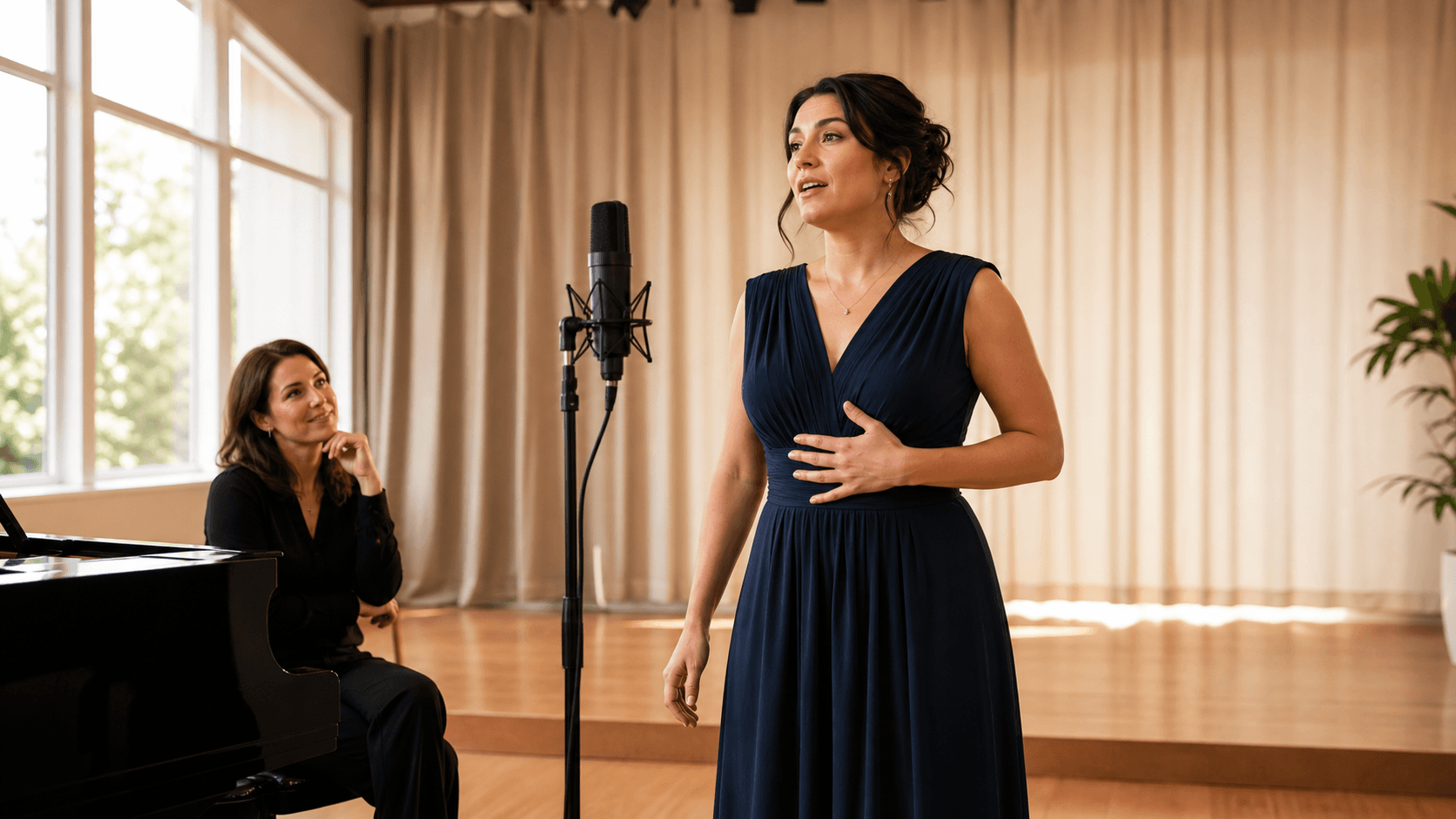
Find Calm and Confidence Every Time You Step Onstage
Stage lights, warm air, a crowd starting to settle. Your heart beats a little faster as you wait in the wings. It could be a summer festival set, a Sunday service, a local theater show, or an open-mic night at a neighborhood spot. No matter the stage, that mix of excitement and nerves can feel huge.
Many adult singers know this moment well. Maybe your breath turns shaky, your mouth feels dry, or your shoulders creep up toward your ears. You might worry your voice will give out, or that you will blank on a lyric, or that you will lose the emotion of the song once the lights hit your face. That is where holistic voice coaching comes in.
At Restore Studios, we use something we call the Vocal Freedom Formula, built on three parts: Vocal Alignment, Artistic Identity, and Performance Readiness. Instead of only drilling high notes, we help you line up your mind, body, and voice so you can walk onstage feeling present, grounded, and expressive. Let us break down what holistic voice coaching really is, how it builds real stage confidence, and some simple steps you can start using before your next performance.
What Holistic Voice Coaching Really Means
Holistic voice coaching is about working with the whole singer, not just the sound that comes out of your mouth. We look at your thoughts, your emotions, your body, and your vocal technique together so your voice can work freely and more consistently.
A holistic session might include things like:
- Breath awareness and simple body alignment
- Gentle stretches for your neck, jaw, and shoulders
- Nervous system calming, like steady breathing or grounding
- Vocal exercises that match the songs you are working on
- Time to reflect on how singing actually felt in your body
This goes beyond singing the song again and again. Of course, we still use scales, warm-ups, and work on melody, rhythm, and style. Traditional voice lessons that focus on solid technique are helpful and important. The difference here is that we connect that technique to real-life situations, like a long worship weekend, a run of shows, or a late-night club set.
Holistic does not mean vague or mystical. It is practical and structured. The goal is to give you clear tools you can use in rehearsals, services, gigs, auditions, and recording sessions. When your mind, body, and voice are working together, you are less likely to feel like one person in practice and a completely different singer onstage.
How Holistic Voice Coaching Builds Real Stage Confidence
True stage confidence is not just about liking your tone on a good day. In our Vocal Freedom Formula, we look at three pillars that support you every time you sing: reliable technique, a clear sense of artistic identity, and real-world performance skills.
For Vocal Alignment, we help you:
- Release extra tension in places like your jaw, tongue, and shoulders
- Balance your breath and resonance so notes feel more supported
- Build simple care habits so your voice stays healthier over time
When your voice feels familiar and dependable, you do not have to guess if that high note will show up. You can trust it, which frees you to focus on the song.
Artistic Identity is about knowing what you want to say as an artist and how you want to sound. When you have that clarity, you stop copying other singers or chasing what you think people want to hear. You start making intentional choices about phrasing, dynamics, and style that fit who you are.
Performance Readiness means practicing for real stages, not just the practice room. That might look like:
- Walking on and off as you would in an actual show
- Running your set in order, with the same speaking moments and transitions
- Trying different pre-show rituals to see what calms your nerves
- Learning how to respond when something goes off, like a crack, a missed cue, or a late entrance
The emotional shift can be big. Instead of fighting your nerves, you learn to notice them and work with them. Instead of chasing perfection, you aim for presence and connection so people do not just hear you, they feel you.
Signs Holistic Voice Coaching Might Be Right for You
Not every singer needs the same thing. But there are common signs that a holistic approach might be helpful, especially for adult singers juggling busy lives.
You might relate to things like:
- Your voice feels tight or tired after gigs or services
- You sound strong in practice, but less steady under lights
- Your warm-ups do not seem to translate once you are onstage
- You feel like your throat closes up when you get nervous
On the confidence side, maybe you:
- Second-guess your sound as soon as you hear a recording
- Worry more about being judged than enjoying the song
- Feel like a different singer when nerves hit
- Hold back your true style because you do not feel safe to let go
You might also feel stuck artistically. You have some technique, but your singing does not match how you hear songs in your head. You are not sure what kind of artist you are, or you are stepping into more visible roles, like worship leading or featured gigs, and want to feel more grounded.
You do not need to be in crisis to benefit from holistic voice coaching. Many singers come in because they are doing fine, but they want more ease, clarity, and joy in their singing life.
Inside a Holistic Session Focused on Stage Readiness
So what actually happens in a holistic session when we are getting you ready for a performance weekend or a local show?
We often start with grounding and body alignment. That might be:
- Feeling your feet on the floor and softening your knees
- Taking a few slow, steady breaths and noticing your ribcage move
- Light stretches to relax your neck, jaw, and shoulders
Then we move into targeted vocal work. Instead of random exercises, we choose ones that match your set list. If your songs have long sustained notes, we work on breath and support. If they have lots of riffs, we work on agility. If you move between chest and mix a lot, we practice smooth transitions there.
Performance practice is built in, not saved for the last minute. We might run your song as if you are onstage, with the same movement and mic placement you plan to use. When nerves show up, we pause, notice where they land in your body, and adjust breath, mindset, or phrasing.
After each run, we do a quick check-in. What felt grounded? What felt shaky? We pick one small adjustment to carry into the next run, so you leave with simple, repeatable steps you can use in rehearsal and then onstage.
Simple Holistic Practices You Can Start Using Now
You do not have to change your whole routine to start feeling a shift. Here are a few small practices you can try before your next rehearsal or performance.
Before you sing, take two or three minutes to:
- Breathe in gently through your nose, out through your mouth, a few times
- Roll your shoulders and release your jaw
- Set a quiet intention, like "I want to feel steady" or "I want to connect with the lyrics"
During warm-up or between songs, do quick alignment checks:
- Feel your feet on the ground and keep your knees soft
- Notice your ribcage movement as you inhale
- Release any clenching in your tongue and jaw
Add a brief mental reset by choosing one helpful phrase, such as "I am prepared," "I am present," or "I am here to share," and repeat it while you warm up. It is a simple way to steer your thoughts toward support instead of fear.
Try building a short, realistic warm-up habit, even just 5 to 10 minutes before rehearsals or services. Choose exercises that feel good in your body and keep your voice fresh, not wiped out.
These are small examples of holistic voice coaching in action. When your mind, body, and voice are in the same conversation, your singing becomes more stable and expressive, without needing hours of extra practice.
Discover How Strong, Healthy Vocal Habits Can Elevate Your Performance
If you are ready to move beyond quick fixes and build a voice that feels free, reliable, and expressive, we are here to guide you. At Restore Studios, we look at your whole self so your technique, mindset, and body all work together in support of your sound. Explore our holistic voice coaching to find the coach and approach that fit your goals. Let's take the next step toward a voice that supports both your artistry and your well-being.