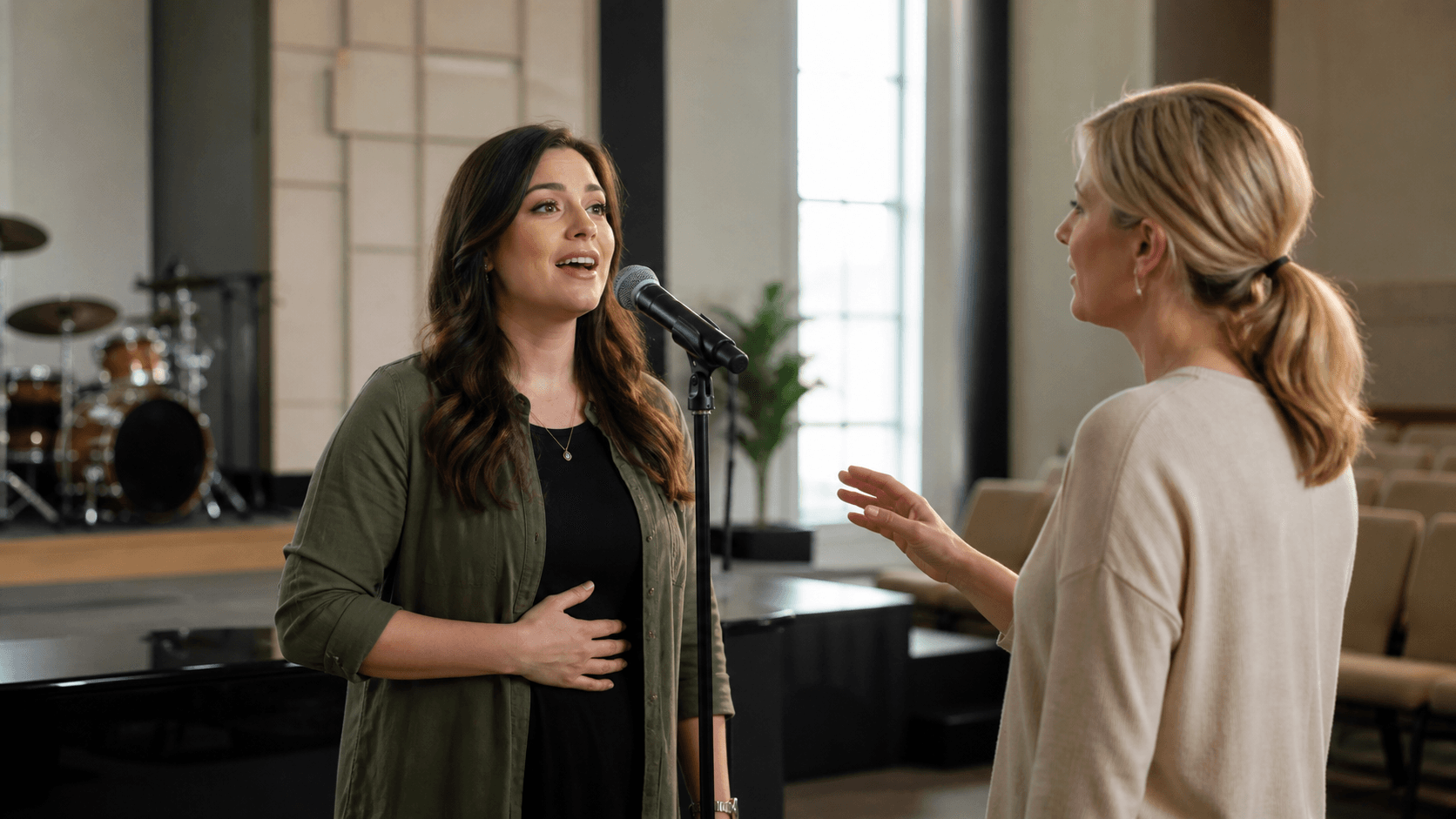
Singing With Freedom on Sunday and Beyond
Vocal freedom technique is not about singing louder or doing more tricks. It is about feeling like your voice will actually show up for you when you stand on stage, week after week. If you lead worship, you carry both the music and the room, and that asks a lot from your body, mind, and voice.
As fall kicks in, schedules fill up with extra rehearsals, conferences, and holiday prep. Many worship leaders start to wonder if their voice will hold up through every service, every key change, and every big bridge. That is why we care about a new way to think about vocal freedom, one that helps you lead with passion without burning out your voice.
At Restore Studios, we use what we call the Vocal Freedom Formula. It has three parts: Vocal Alignment, Artistic Identity, and Performance Readiness. In this article, we are taking that same framework and looking at it through the real-life demands of worship leading, so you can start to use it this Sunday, even if you do not see yourself as a "professional singer."
What Worship Leaders Really Ask of Their Voices
Leading worship is not the same as singing one song at a concert. You are often:
- Singing through multiple services in a row
- Rehearsing during the week
- Speaking between songs, hosting moments, or praying out loud
- Adjusting keys, songs, and flow in real time
That is a lot. No wonder many worship leaders feel:
- Tired or raspy by the last service
- Unsure if high notes will come out clean
- Tight in the throat when the room gets emotional
- Torn between caring for their voice and caring for the congregation
Most people in ministry are used to pushing through with adrenaline, coffee, and faith. But the voice is part of the body, and the body has limits. This is not about fear. It is about having a clear, kind plan that supports the calling you already carry.
For worship leaders, vocal freedom technique has to do more than fix vowels or high notes. It has to speak to your nervous system, your leadership role, and the live, sometimes unpredictable nature of worship.
Reframing Vocal Freedom Technique for Real Services
We like to define vocal freedom technique as the ability to sing, speak, and lead with consistency while staying grounded and present. It is not just, "Can I hit the note?" It is, "Can I stay connected to God, to the lyrics, and to the room, while my body and voice stay steady?"
Here is where your nervous system comes in. When stage pressure, tech issues, or last-minute changes hit, your body can flip into fight or flight. When that happens:
- Breathing gets shallow and high in the chest
- The larynx tends to lift and grip
- The tongue and jaw may lock up
All of that shows up as tension in the sound. Instead of thinking, "I need to push more," we can reframe it as, "I need to realign my breath, body, and intention." If your voice feels shaky, rather than, "My voice is failing me," try, "My system is stressed. How can I support it right now?"
In worship settings, things rarely go exactly as planned. A song might repeat three more times, a spontaneous chorus may start, or a quiet moment might turn into a big anthem. When your vocal freedom technique includes grounding tools and flexible habits, those shifts feel less scary and more like space to respond.
Aligning Body, Breath, and Belief on Stage
The first part of the Vocal Freedom Formula is Vocal Alignment. Alignment is not military stiff. It is more like giving your body a stable base, so breath and sound can move without fighting your posture.
On stage, a few common patterns show up:
- "Worship hunch," where shoulders roll forward and ribs collapse
- Locking knees while holding a mic or guitar
- Leaning into the stand or screen instead of your own support
You can reset your alignment in simple ways between songs:
- Feel your feet: Place them about hip-width apart, weight spread through heels and toes.
- Unlock your knees: Soften them just enough that you could gently bounce.
- Float your chest: Let your ribs widen a bit, like you are making space inside for breath.
Breath support in a ministry setting has to work for both singing and speaking. When emotions run high, it is easy to grab air from the top of the chest and hope for the best. Instead, try:
- Letting the belly and low ribs move as you inhale
- Planning breaths on punctuation in your speaking moments
- Treating big anthem phrases like waves, not walls, riding breath through them instead of attacking them
What you believe as you sing also shows up in your body. If you feel like you must prove something, the body may grip. If you sing from trust, you are more likely to allow release. Aligning body, breath, and belief turns technical work into worship, not a separate activity.
Honoring Your Artistic Identity in a Team Context
Artistic Identity is the second part of the Vocal Freedom Formula. For worship leaders, this means your natural tone, phrasing, and emotional style, even when you are singing songs everyone knows from the same playlists.
There is a real tension here. Many leaders try to copy the sound of popular worship artists, including their exact tone, rasp, or belting style. Copying can be helpful for learning, but staying stuck there can strain your voice and blur who you are.
To honor your voice in your context, you might:
- Choose keys that match your range, not just the original track
- Let your natural tone come through, whether it is bright, warm, airy, or bold
- Adjust riffs or big money notes so they sit where your voice is strong
When your vocal freedom technique is built around your real instrument, not someone else's, it becomes more sustainable. You are not fighting your own design every Sunday. You are leading from the voice you actually have.
Performance Readiness for Sundays, Conferences, and Holidays
The last part of the Vocal Freedom Formula is Performance Readiness. This is more than a quick "la la la" in the car. It is how you prepare your whole system for the load ahead, especially in busy fall and holiday seasons when services can stack up.
A simple pre-service flow might look like:
- Gentle nervous system resets, such as slow exhales, light stretching, or grounding your feet on the stage
- Targeted vocal warm-ups that match your set, including mix, head voice, chest voice, and some spoken lines
- A short mental walkthrough of the service, focusing on presence and flow instead of perfection
Pacing also matters. You and your team can:
- Share big songs across different leaders
- Notice early signs of fatigue, like extra breath noise or loss of power
- Plan recovery pockets into your week as much as your calendar allows
When you show up with this kind of readiness, you are not just hoping your voice works. You are partnering with your body so you can serve steadily across every season.
Bringing Vocal Freedom Into This Sunday's Set
So what do you do with all of this right now? Pick one small shift for this week. Maybe you:
- Add a 3-minute grounding and breathing reset before soundcheck
- Try a simple alignment check between songs
- Choose a more relaxed, supported approach to the highest note in your set
After Sunday, take a quiet moment to reflect. What felt a bit easier? Where did tension show up? What part of vocal freedom technique are you curious to build next?
At Restore Studios, we see vocal care as an act of stewardship, not selfishness. Caring for your voice supports your team, your congregation, and your long-term calling. Vocal freedom is not a finish line you cross once. It is a gentle, ongoing practice that lets you sing and lead with more ease, honesty, and confidence, no matter how full the season becomes.
Unlock Confident, Effortless Singing Today
If you are ready to let go of strain and unlock your most natural voice, we are here to guide you step by step. At Restore Studios, our experienced coaches use a proven vocal freedom technique to help you build healthy, expressive, and reliable vocal habits. Schedule a session with us to start feeling more control, ease, and enjoyment every time you sing.