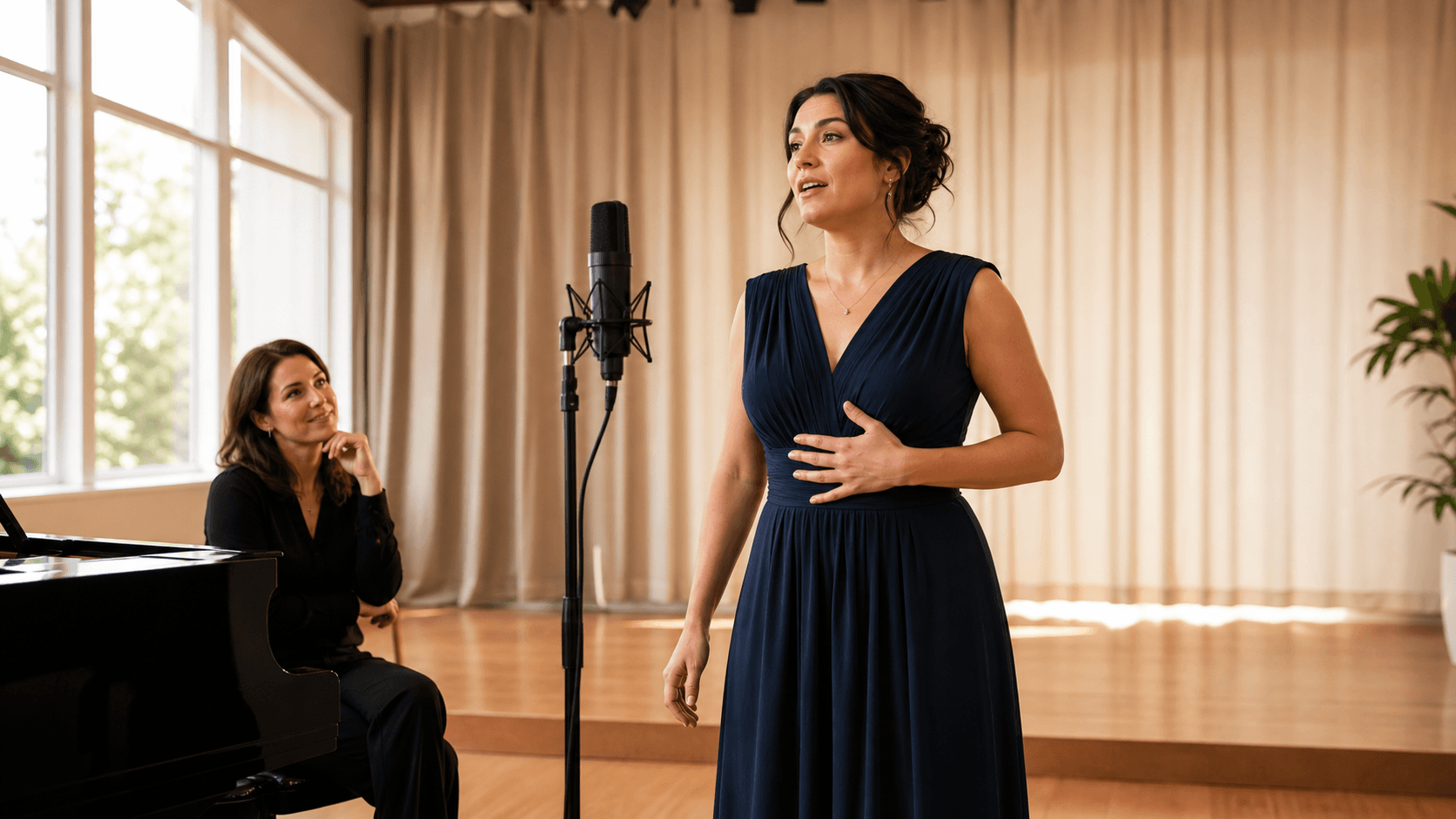
Hear Your Voice Clearly, Without the Guesswork
Hearing your voice on a recording can feel like a shock. It comes out of the speaker and you think, "That does not sound like me." For singers, that can be even more intense. You might feel discouraged, confused, or suddenly unsure about your voice at all.
What you hear in your head is mixed with sound traveling through your bones and skull. A recording only gives you the sound traveling through the air. So playback strips away that extra inner layer, and what is left can sound brighter, thinner, or just unfamiliar. This is normal. Nothing is wrong with you.
At Restore Studios, we care about making that moment less scary and more useful. In this article, we will walk you through a gentle self-assessment framework using simple recording and playback. Our goal is to help you uncover your authentic singing voice and build trust in it over time, whether you are getting ready for late-summer gigs, worship leading, or a busy stretch of fall performances.
What an Authentic Singing Voice Really Is
When we say authentic singing voice, we are not talking about some perfect, polished sound. We mean a way of singing that feels like it belongs in your body. It feels natural, honest, and repeatable, even when your day is not perfect.
An authentic singing voice usually has a few things in common:
- Your throat and jaw feel mostly easy, not squeezed
- Your breath flows without you gasping or pushing
- Your sound stays fairly steady from day to day
- Your emotion feels real, not acted or forced
Authenticity is not the same as perfection. You do not have to sound like your favorite artist or hit every single note like a studio track. Instead, think in terms of:
- Consistency rather than control
- Ease rather than effort
- Truthful expression rather than tricks
This is where the mind, body, and voice connection comes in. When your thoughts are calm, your body is grounded, and your breath is steady, your voice can reflect the whole you. If your shoulders are tight from stress, your thoughts are racing, and you are barely breathing, the sound will show that too. Recording is one way to notice that connection and start to care for it.
Set up a Safe, Simple Recording Ritual
To get honest feedback, you do not need fancy studio gear. You need a small ritual that feels safe and repeatable. That way, your brain can stop worrying about tech and settle into the experience.
Try this:
- Use the same quiet room when you can
- Record around the same time of day
- Use simple tools, like your phone, laptop, or a basic mic
Next, choose your material. Pick:
- One or two short songs, or just a verse and chorus
- Songs you already know fairly well
- Lyrics that mean something to you emotionally
- One simple warm-up, like a scale or easy pattern
This gives you two views of your voice: how you sound in exercise mode, and how you sound when you tell a story through song.
Before you hit record, prep your mind and body:
- Take 3 slow, low breaths, feeling your ribs move
- Gently roll your shoulders and stretch your neck
- Drop your jaw with a soft sigh
- Set a clear intention, like, "I am here to observe, not judge"
A small ritual like this can calm nerves, even on hot, sticky late-summer days when energy is low and life is full.
Listen Back Like a Coach, Not a Critic
The first time you press play, your inner critic may jump in right away. We want to shift that voice toward a curious coach instead of a harsh judge.
Try a two-step listening process:
- First listen, no notes
Just listen once, from start to finish. Notice your overall feeling. Do not pause or rewind. Ask yourself:
- What words come to mind, like bright, heavy, airy, strong, shy?
- How does my body feel while I listen?
- What is one thing I like, even a small detail?
- Second listen, with focus
On the second round, you can pause and rewind. Focus on a few simple elements:
- Breath flow: Do phrases feel steady or choppy?
- Tone quality: Where does it sound free, where does it sound tight?
- Emotional connection: Do I believe myself on this lyric?
Use a small notebook or notes app to track patterns over time. You might write:
- "Chorus: felt easy and open"
- "High note: jaw got tight, sound went sharp"
- "Bridge: I checked out emotionally"
Keep your language neutral. Avoid harsh words like "terrible" or "awful." Think in terms of "tighter here, freer there." That makes space for growth.
Map What You Hear to What You Feel
Now we start to connect playback with body sensations. This is where your authentic singing voice starts to show itself.
As you listen, pause at key spots and ask:
- What was my jaw doing here? Tight or loose?
- Was my breath held, shallow, or supported from low in my ribs?
- Was my posture slumped, or did I feel grounded on my feet?
You might notice:
- When your jaw opens and tongue rests, your tone gets warmer
- When your shoulders relax, your vibrato steadies
- When you stand tall, your pitch locks in more easily
Then check in with your emotions. Ask yourself:
- Where did I feel self-conscious or like I was "performing at" the listener?
- Where did I feel like I was just telling the truth of the song?
- Did I push on big notes to impress, or did I stay connected to the story?
Over several weeks of recording, this mind, body, and voice map becomes clearer. You start to notice small signals in real time, like, "My neck is grabbing, I may be slipping away from my authentic sound," or, "My breath feels easy, this is the version of my voice that feels like me."
Gentle Experiments to Bring Out Your True Sound
Once you have some notes, you can do small, kind experiments. Think of these as tiny tweaks, not big makeovers.
In your next recording session, try one change at a time:
- Sing the same phrase a little slower so your breath has space
- Soften the volume on high notes and see if they feel freer
- Try the song a step lower or higher to find a more comfortable key
Before you sing the song, add a few easy technique tools:
- Relaxed sirens on "oo" from low to high, like a slide
- Lip trills or tongue trills to warm up breath and airflow
- Gentle humming on the melody, feeling vibration in your face
You can also try a "speak then sing" exercise. Speak one line of the lyric like you are talking to a friend. Then sing it right away, keeping that same natural feeling in your mouth and body. This can pull your singing closer to your real speaking voice, which often points toward your authentic singing voice.
The goal here is exploration, not fixing. With each experiment, record again and notice: Did this change make things easier, more honest, or more tiring? Over time, you uncover what truly supports your voice on long rehearsal days, busy weekends, and full worship sets.
Turn Your Insights Into a Supportive Practice Plan
Now you can turn your insights into a short, gentle routine you can keep, even as fall schedules fill up.
Try a simple structure:
- 5 to 10 minutes of warm-ups that target your main patterns
- 5 minutes on one small section of a song
- One quick recording
- 3 to 5 minutes of listening and journaling
Two or three sessions per week are often enough to notice change, as long as you stay present and kind with yourself. You might track small wins like:
- "High notes easier today"
- "Less neck tension on the bridge"
- "I believed myself more on the chorus"
These small wins are not small at all. They build real confidence and self-trust.
If you want more guided support with this process, mind-body-voice coaching at Restore Studios can sit alongside your recording ritual. Professional feedback can help you sort what to keep, what to shift, and how to keep your authentic singing voice healthy and consistent through each new season.
Unlock The Confidence Of Your Authentic Sound
If you are ready to move past imitation and discover how your voice is truly meant to sound, we are here to guide you. Our coaches work alongside you to build healthy technique while honoring your unique style and goals. Start exploring your authentic singing voice with personalized support designed for real-world performing and recording. At Restore Studios, we help you make lasting changes you can actually hear and feel.